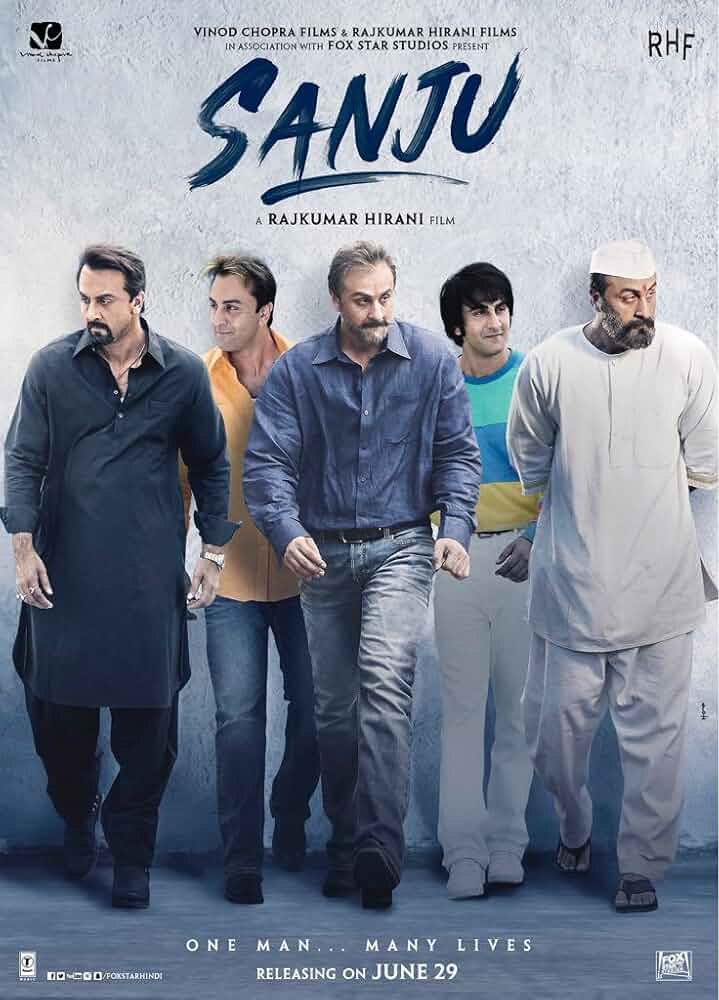
Review of Sanju

Sanju (2018) Review – A Good Film, Without Conviction

Sanju (2018): A Good Film, Without Conviction

Third good movie in a row in 2018! But I call Sanju a good movie without conviction.

It’s been a week since I saw Sanju — twice — and I’ve been grappling with myself over how this film should be rated. While sipping ginger-laced chai on my balcony, it finally dawned on me why I felt so conflicted.

This is a film that wants to move you, inspire you, and absolve its protagonist — and it mostly succeeds. But it does so by sanding down edges that perhaps should have remained rough.

The Problems Are Real

To begin with, the movie has many flaws — and they are not small ones.

  • There are very few scenes where Ranbir Kapoor actually looks or acts like Sanjay Dutt. The rest is filled in generously by our imagination.
  • The make-up used to age Sanju is unintentionally comic. That’s what happens when prosthetics are overworked.
  • The editing feels shoddy in parts, especially when emotional beats are rushed.
  • Winnie the ice babe suddenly turns into Winnie the weeper — with no believable transition. Come on, don’t take us for granted.
  • While I understand Hirani’s trademark humour — lightening serious situations — the Boman Irani dead-body scene crosses a line. The slapstick background score only makes it worse.
  • This story unfolds in the 80s and 90s, not the 50s and 60s. The costume design feels oddly dated, as though the period itself wasn’t trusted enough to speak.

Sorry, Mr. Hirani. I had to point these out.

So Why Does It Still Work?

Despite these shortcomings, I will still label Sanju a good film — just not a brilliant one.

At a broad level, it’s a classic fighting-all-odds story, and those are inherently inspirational. Indian cinema thrives on redemption arcs, and this one is tailor-made for audience empathy.

At a more personal level, each one of us connects with Sanjay Dutt differently.

For a teenager, it’s Munnabhai. For the twenty-somethings, it’s Vaastav. Rewind further and you hit Khalnayak, Saajan, Rocky.

We all “know” this bloke — or think we do. Naturally, we want to know what really happened. That curiosity alone hooks the audience.

The Emotional Formula

On another plane, the film tugs at two deeply effective emotional threads: the father-son relationship, and the unwavering loyalty of a friend.

That’s the formula. And it’s a winning one.

But formulas also simplify. And simplification is where Sanju begins to feel safe instead of searching.

The Final Question

I often wonder how someone with no prior emotional relationship to Sanjay Dutt would react to this film.

Someone who hasn’t grown up watching his films. Someone without nostalgia. Someone without context.

Know anyone like that?

That, perhaps, is the real test of this movie.

Comments

PRM said…
Very concise and nicely written. I think the pathetic “whitewashing” of Sanjay Dutt’s life By using a “romantic” hero does not do well for the authenticity.

The mainstream movies already get a lot of reviews. Can you start reviewing some off the beat movies too?

- Your continued reader

Popular posts from this blog

1/35: Why I loved Pather Panchali (1955)

Pather Panchali (1955) Review | Satyajit Ray’s Poetic Debut Pather Panchali (1955): Satyajit Ray’s Poetic Debut Why on earth had I not watched any Satyajit Ray film till now? Puzzles me. But I'm setting out to watch every film made by the great man. Pather Panchali is my kind of cinema. Simple, yet complex. Subtle, yet bold. Rambling, yet assertive. The story is quite loose and banal, but it is the telling of the story that makes an impact. What drew me to the film is the play of characters, and the attention to detail. Your heart goes out to each of the pivotal characters — Sarbajaya , the forced matriarch; Durga , the dreamy daughter; Apu , the boy turning into a man; and Indir , the penniless beggar. Each of them tells their own story, not through words, but through their eyes and body language. Usually, in a film, you can make out the star of the show, but you can'...

Nuggets of Sholay: One - Oont Pahad Ke Neeche

Nuggets of Sholay #1: One Oont Pahad Ke Neeche Nuggets of Sholay #1: One Oont Pahad Ke Neeche (ओँट पहाड़ के नीचे) I must confess, starting this series of Nuggets of Sholay has been immensely joyful. Every line I researched, every scene I analyzed, brought me closer to the genius of Salim–Javed. Muhavra: One Oont Pahad Ke Neeche (ओँट पहाड़ के नीचे) This proverb literally means “a camel under a mountain,” describing something impossible or absurd. In Sholay , this phrase was delivered with perfect comic timing. The story behind the muhavra: Once upon a time, there was a proud and arrogant camel. He strutted around the village, convinced that no creature could be taller, stronger, or more important than him. Every other animal bowed, every human smiled nervously, and the camel’s ego swelled bigger with each passing day. One day, the camel’s owner decided it was time for...

12/35: Mahanagar (1963) - A simple woman in a big city

Mahanagar (1963): A Simple Woman in a Big City | Sachit Murthy Mahanagar (1963): Satyajit Ray’s Quiet Revolt Satyajit Ray returns to black and white after Kanchenjunga with Mahanagar in 1963. Man, this fellow could churn out films at an astonishing pace. And he returns with a bang. This one is an absolute classic. Mahanagar is the story of Arati Mazumdar, played by Madhabi Mukherjee . A simple housewife in an orthodox household, the film charts Arati’s journey—from being gently hemmed in by domestic expectations to stepping out into the world to financially support her family, and finally to standing up to injustice, even at the cost of upsetting the very financial applecart that sustains them. Madhabi Mukherjee as Arati Mazumdar — a woman whose revolution is ethical, not theatrical. The film makes a strong statement on the value of women in society, and not just through Arati. Ray spreads this id...

Sachit Murthy — Writing on Cinema, Cricket, Travel, and Life in India

This blog brings together essays, reviews, and observations on cinema, sport, travel, and everyday life in India. It moves between detailed writing on Indian and world cinema, reflections on cricket as culture and memory, travel notes from cities and small towns, and personal pieces shaped by living and working in contemporary India. Film writing on the blog ranges from close readings of classic and modern films to broader reflections on performance, narrative, and form. Cricket appears not as statistics or news, but as lived experience — a shared language of time, obsession, and belonging. Travel pieces pay attention to place, atmosphere, and the small details that define movement and return. Underlying these varied subjects is a consistent interest in observation: how people speak, perform, remember, and negotiate their inner and public lives. The author’s background as a stage and screen actor, writer, and voice artist informs the attention to rhythm, silence, and point of view across the writing. The blog is intended for readers who enjoy reflective, unhurried writing — pieces that sit somewhere between criticism, travelogue, and personal essay.